Tuesday, March 20, 2012

Personal Efforts to Create a Sacred Economy


The last big thing I was in, was putting a team together. At some point the decision was "yes, I need a team". Two friends expressed interest in being on board, one of them has been involved for a couple of months now, and another one came in very recently. The process however has been slow if not stagnant: We still are trying to get us 3 to email our personal visions and goals with this project, not even the shared vision yet. So I figured it was going to take way longer that what I had thought it would...if anything happened at all. 

Another factor that came to mind was the comment by one of them who told me in relation to this post "we can't really wait...the world can't wait until you finish a Ph.D...that's between 3 to 7 years!!". It made complete sense. I started to hear a lot about the word "solopreneur" and I thought maybe that's what I am, or maybe that's the role I need to play right now. That doesn't mean I'm saying no to others, or that I decided to forget about the team. It means that I'll start (again) while the team gets moving. If it doesn't move, then I'll have something to keep working with rather than just sitting and waiting.

So...that's probably the front page of the newspaper. I'll give it a go as a solopreneur. After reading Business Model You and in combination with inspiration from the book Sacred Economics by Charles Einstein, I started to think that my blogs are my products and the general "hub", The New Economics for Humanity, is my organization. If I am a solopreneur, then I need to understand and make the appropriate changes to my personal business model. I need to understand what sort of value I provide within my own organization, that is, who do I help? How? How do I interact?? How do others know me and how do I deliver? how do I interact with them? What do I do?? Who Am I and what do I have?? Who helps me?? What do I give and what do I get?? These are the building blocks of a personal business model. 


That's my new standing point. Now the question is, how can I make of this blog a business that is aligned with what I believe, that allows me to behave like a cell of the earth??. I also have to start drawing a business model canvas for the NEH as an organization. Here is where I'm going to start applying the concepts of Steve Blank (customer development), Alexander Ostenwalder (Business Model Generation), Tim Clark (Business Model You) and Charles Einstein (Sacred Economics). These books are what I call my business combo. 


In the midst of all this, I found myself inspired by a friend whose recent story pushed me to explore a new idea. And this new idea can actually make use of some skills I've been acquiring since 2005. It involves sports (ultimate disc) and Aboriginals, from whom I'm hoping to learn about cash less economics and understand who they are. If it all starts moving, it will be interesting to see if and how the club incorporates indigenous traditions and western culture specially to be able to overcome some potential financial issues that may arise (think about getting uniforms, flying to and paying for tournaments). Find the proposal here


The journey looks promising and daunting at the same time. I have restrained myself from writing enormous amounts of blog posts until I start something officially. My new addition to the library is now home with me (The Startup Owner's Manual by Steve Blank) and looks like I have a hell of work ahead of me. I never thought it was gonna be easy though.


Improving Productivity: Emails

My Gmail is clutter free and now...I don't check it every day!! Thank you activeinbox!!! I went from 2000 emails to 0 in one afternoon. Boring at the beginning, then I got the hang of it and started trashing things like it was the last day of my life....great feeling that of getting rid of so much stuff. I guess it feels the same when you finally face the house big clean up project that you've been avoiding for so long. Now I have another task...get my 3 old yahoo accounts in order and forwarding and filtering emails to gmail. I already started with one and still feel comfortable with getting so many emails and not really processing them straight away. Once I get to a number that looks kind of big (somewhere between 40 and 100 emails), then I go and process them all at once. By "processing" I mean, I open them, if they have links for me to read, I click the links and let them sit there until I finish with Gmail. Once I'm done with gmail, then I go to the open pages, if they are something I only need to skim, then I do so. If I'd like to read it properly then I use klip.me extension for Chrome wich pushes the article from the web to my kindle (it's been amazingly useful!! you can push things to your mobile if not a kindle user, check www.klip.me). Usually, there is one day in the week where I find enough time to read the articles I've been pushing and I don't have to be in front of the computer.

With Activeinbox I can set up pretty useful labels in Gmail. So what I did was: In Nozbe I had a look at my projects and categorize them in my mind by "active", "inactive" and "closed". Then I went to Evernote and created the tag "Projects" with 3 subtags (active, inactive and closed), and in each subtag I created the relevant sub-subtags with the names that correspond to my Nozbe projects. Then I went to Gmail and configured my label types (C/ for Contexts, R/ for references P/ Projects and S/ for Status). The P/ type is consistent with what I have in both Nozbe and Evernote. 


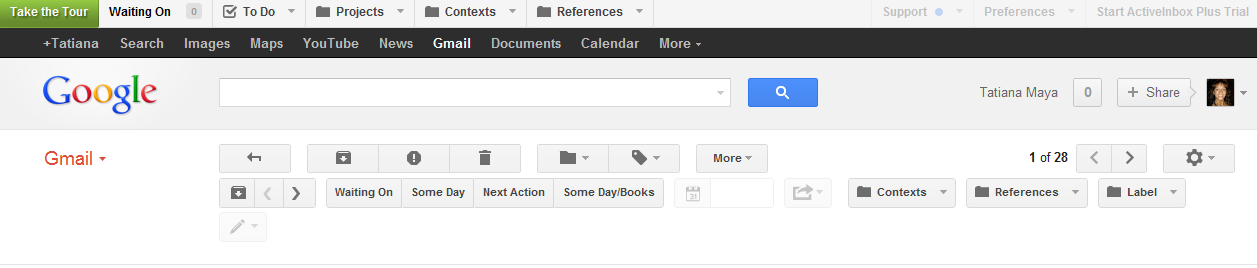
When I create labels, then active inbox adds them at the top, integrated with Gmail's horizontal menu. The  good thing about it is that I can spend less time thinking about what I want to do with those emails or where I want them to go. If I've decided what it is that I need to do about it, then I click on "next action", which is a S/ type. I can also click on the Contexts drop down menu to assign it whether that task is an errand, call, at computer, etc. If the email belongs to a specific project, then I click on the "label" drop down menu and assign it accordingly. This "label" menu is the one that lets me assign emails to active, inactive and closed projects. I don't really understand why it assigned "label" as opposed to "projects" but, so far, it works for me like this so I'm not worried about it.


I'm not going to go much further because writing about it is probably not the best way to share the experience. I would be happy, however, to have a skype call, or call conference and share my screen to play a bit with the three tools so that you have more of an idea. Again, I'm still learning tips about all of them but I'm definitely making progress. It has reduced my "email checking time" considerably (to between 2 to 4 times a week as opposed to everyday and many times during the day) and I'm getting used to seeing emails piling up in my inbox until I make the decision to clean up. When I decide that "that's big enough a number" I go and get rid of them all in one go. 

At the moment I have a free account with ActiveInbox. When you're ready, you can start a 2 weeks trial of their premium service. I plan to do that once I have migrated all my emails into my gmail account to test the premium at its maximum. Give it a go if you are a Gmail user. 

Sunday, February 19, 2012

Ready...set.....GO!


I've been reading The 4 Steps to the Epiphany by Steve Blank. I couldn't have decided to open the book and start reading at a better time! Just right for this new stage of the NEH and the Cells of the Earth project. So I thought I would start applying its advice, which in fact, is very related to Business Model Generation and I am very excited about the new book, The Startup Owner's Manual, with the integration of the two concepts, to be launched in March (pre-order: Ticked!). This book [The 4 steps to the epiphany] is all about the Customer Development concept and process. The first advice I took was what I read as "make sure anybody who might be in your team, knows and agrees to use the Customer Development process"...That is why I'm writing this.

So I thought that in order to agree on using the Customer development process, we need to know what the process is, what kind of effort it implies and what we're meant to do in each of the stages. To fulfill that need without having to buy the book I decided to go through a kind of painful process: Creating a Prezi about it. The editing is painful, but there are big rewards, the concepts are definitely staying in my mind. Here it is. I suggest you use the full screen mode to watch the presentation, otherwise some parts will be hard to read. It is not too visual, but it is definitely not as long as the ...you gotta be kidding me!!...looking at how many pages the book has (282), I just found that there is a summary of all what I've been doing for the last 2 days...any way...it's not too visual, but it is very helpful and very much worth it to make the decision to agree or not on it. I'm wondering if The Startup Owner's manual is going to change much what I know about Customer Development and Business Model Generation...just wondering.


After you play with the presentation, you'll notice I'm on Phase 0: Getting a team to buy-in the process, core values and to present my problem hypothesis and product vision so we can start Phase 1. I think this corresponds to the Mobilize stage of the Business Model Generation process, which I found hard to get going because I didn't really have the instructions I found in Blank's book. I also wanted to mention that I won't worry much about using the mainstream business vocabulary. Although I don't agree with much of it, I hope that the description of the hypothesis will put it clear what I am about. My intention is to use mainstream business vocabulary to start with and "upgrade" to what I'd think is a more appropriate vocabulary later, when the startup starts using its own invention to recreate itself. 

I'm using this evernote notebook to keep all my notes related to the first step of the Customer Develpment process, which is Customer Discovery. So everything you need to know about it, will be there. Check for updates. 

Let's Get Productive!!

One of the things I'm doing to start fresh with the NEH and my life, is getting my head organized. Looking for how to do this, I found that I needed to become more productive. That was the key word. I needed to find a way to be able to explore and do a lot of things I dream of doing without driving myself to exhaustion with an imbalanced life as I was doing. So if you think you should look at doing the same, I've found some tools that are taking me out of the hole. Pack your believes in a box while you read about them and when you finish, open the box again and see if you can align the new info with what you believe in. 

Getting Things Done (GTD): The title says it all I guess.The foundation to how I do things now and how I'm sinchronizing all my tasks and the different online tools I use. This is a very good introduction and compilation of what GTD is and how it works with lots of links to get informed before you make the decision to read the book and get started. 

Evernote: An AWESOME...AWESOME!!! software that lets you pretty much remember anything and everything from everywhere. I think the easiest way to explore it before signing up is via videos, so this page might help. Of course there is the long option, which is reading their guide.

Nozbe: Another AWESOME software specifically design to put in practice the Getting Things Done approach. This page will probably give you a synthesis of GTD and Nozbe. 10 videos 3 to 5 minutes long each, explaining each of the steps to use Nozbe and GTD).

ActiveInbox: An extension for Gmail that lets you organize your emails according to your GTD system. I'm finding it helpful to help me clean up my cluttered email.


Just so you how I find them useful, let me show you a bit of what I do with the ones I'm using every single day of my life since a January 2012: Evernote and Nozbe. Inevitably, since I really do use them, you'll find out about what's happening with the Cells of the Earth project. Let's start with Evernote.


So...you can create all types of notes, you can write them yourself, you can drag and drop files in the desktop version, you can create voice and ink notes, you can clip articles from the internet, pictures and websites. On the far left, you have your notebooks and tags to organize your notes. As you can see, I'm organizing pretty much everything here. You can share your notes and notebooks with some people or with everybody. So here is an example of one of my notebooks. The link will take you to the web version of the notebook. Feel free to read anything in there, that's why I'm sharing it, although mind you, contents are not finished yet. I also used Evernote to get the screenshot by the way.

Evernote doesn't work so much to actually DO things for me.  Although it does have the capability, it would mean that I have to design my own system to move tasks and actions forward rather than just keeping notes in a safe place. There is however, an unofficial guide to create a GTD system within Evernote. It costs $5 but I'm not sure how good it is. So here is where I keep stuff. 

Nozbe, instead, is where I do stuff. 


You can see there all the projects I have. As it is there, it is showing you the tasks I need to do for a particular stage in a process called "Customer Development" that I'm summarizing in this prezi. You can drag and drop your tasks to the calendar, contexts and projects sections to add information to the tasks. Starring them means that they become your priority, and you check your priorities by clicking on "Next Actions" at the top left hand side of the page. Your inbox is where you collect all your ideas and things you'd like to do and have them ready to be processed. "To process" means to decide what action you need to take in order to make that item happen. Then is when they become tasks. So I just check my inbox once a week to keep the flow going.


Now, go to the public notebook on evernote again and click on the "task list" note. Now scroll down and see what you find...YES!! the evernote notes related to the project!!! So...you can link your Nozbe and Evernote accounts and by naming tags in Evernote as you name projects in Nozbe, you link them...how awesome! for me at least! I don't really need to have that task list note there in case it looks redundant to you, it was just to show you the nozbe/evernote integration.


Both services give you an email account for you to send emails to and with both services you can send the emails straight to the project, notebook and/or tag where you wanted it to go. Although that might be useful, I find it a bit hard to use because I have to think about how I named the project, notebook and/or tag in evernote and/or nozbe, in order to send the email properly. That is why I looked for a GTD application for email and found ActiveInbox, which I just recently started to explore so I don't have much to say yet. However, I can tell there is a potential cool feature in the paying service that lets you push emails into you GCalendar(s). The coolest possibility is that Nozbe also lets you synchronize your Nozbe calendar with your Google calendar...so here is the the story:


I linked my Nozbe account to Google calendar. This means that if I create a task that says "call mum" and drag it and drop it on to the Nozbe calendar, it will show up in a Google calendar named "Nozbe". Since I have an Android phone which associated google account is the same I linked to Nozbe, I can choose the Nozbe google calendar to be my default calendar and it will remind me on my phone of the things I have to do that I initially put on Nozbe. I'm not sure if my excitement is because I'm a newbie to these productivity things but it was just so cool to see!! So...if you push an email straight from your inbox gmail to your Nozbe Google Calendar, as opposed to having to go to Gcal page and enter the details,  or to Nozbe Calendar so it shows up in Nozbe GCal, it will do all with the one action: show  up on  your Nozbe GCal, your Nozbe account and it will remind you on your Android phone. 

I'm still discovering a lot of things and the more I understand how they work, the more excited I get about what I can do and my usage has been increasing with my understanding of them. The pricing system of Evernote is very flexible and I would even say generous. To get the most out of Nozbe you have to pay, but the price is relatively low compared to the frequency you'll use it if you find the GTD system appropriate for your lifestyle...I am a happily paying customer. The free version of Nozbe will get you only five projects to work with. As you can see, I have more than that. The free version of Evernote will give you 60Mb data usage per month and 200 or 250 notebooks maximum. The premium version gives you 1GB a month plus other features. I'm still in the free side of Evernote customers.


The most functional version of Evernote in my situation is the desktop one, whereas the web version of Nozbe works the easiest for me. They both have web, desktop and phone app versions so you can be productive on the go if you want to. Although I haven't mastered the whole system yet and I'm still learning and figuring things out, It has been working for me, I hope it does for you. Cells are very productive units and I would think that we are meant to be like that too.


Just so you know...I decided to become a Nozbe affiliate because I truly believe in it and recommended from my heart. I recommend Evernote in the same spirit, just haven't found out if they have an affiliate program. The Nozbe program was way easier to find...actually, it found me. 

Saturday, February 11, 2012

Setting the Stage

Well...new year, new start...

The coming era of the NEH is likely to be about testing ideas in practice, to go beyond my theories. I was offered invaluable help with putting a local team together to work on this project, however, I feel I must unload my feelings about this new approach so that help can be channeled accordingly.

The previous stage of the NEH concluded when I reached a point where I envisioned what sort of business I wanted to create and wrote down my version of an "elevator pitch":  an online platform that provides the business model generation structure and process to [learn to] collaboratively transform socially just, spiritually fulfilling and environmentally sustainable ideas into value creating entities (businesses), by matching pools of entrepreneurs, work investors and  financial investors.

Then, again, all the questions about the how and the imperative to put a team together came to the table...should that team be local and/or global, how can I select "the right people"?? what kind of people do I need?? Isn't there a self organizing path to do this?? How do cells choose who does what and when, what influences their decisions, how would they define value?? Is there anything at all that they wouldn't consider of value?? I felt that there was something missing in the project. Yes, the "elevator pitch" may sound interesting to me, but for a team to agree to work under the same foundations, to agree on some basic/ground "rules" and use them in practice...that's where I felt there was a gap, and that's when I started to think about making some changes about the blog and the project.

I kept thinking about how what I envision would work and there are so many things in our cultural story that I believe require a fresh new start and that are essential to bring that vision to reality, that I thought the project would be better of if it focuses on the refined version of the question that gets me going: How would humans create, capture and exchange tangible and intangible value if we were to the earth, what cells are to our bodies? 

For instance, one of the things that I would like to see in this business project, is making high quality products and services the cheapest so that they are accessible to everybody, they become everybody's right to have, rather than a luxury for those who can afford it. Why is clean water, quality institutional education, high quality health services, organic food, energy and water efficient products, the most expensive things to get?? Yes, mainstream economics have an answer for this, but to me it is non-sense. If cheap means labor abuse, environmental degradation, social injustice, work/wage slavery...shouldn't these things be actually very expensive so that people don't get them and then we reduce stimuli for their production and increase pressure for their improvement?? Prices and costs should reflect quality in the opposite way we've been using that equation where cheapest means excellence and quality in every sense, expensive reflects negative customer satisfaction and low value. Would a cell work very hard and drive itself to exhaustion for something that creates cancer in its host body?? I think a cell does look for minimum pay for maximum return, what the value of the return is very different to that of human societies...so the question of what it is that we should value comes in handy.

Those are the sort of questions I would like to explore. I feel I need academic support, I would love to maybe accompany this project with a Ph.D because I sense that a mix with that side of cultural knowledge and science would give us more understanding of the possibilitiesThe bit that excites me the most so far, is that this exploration forces me to look at what we consider of value, define it and redefine it in different ways, which is in fact, what I anybody who might come to the team will have to explore as well, and we'd all have the freedom to create our own believes and set our own theories and run experiments to test them accordingly but all based on the same question, all to generate a pool of possibilities from which our societies would choose those more adept to their conditions and evolve. The problem is, is there such a thing as value for a cell, is there anything that a cell does that is not of value for it or for its host body?? So that makes me think...should I change the question to: If business where to behave like cells, what would they do?? how would they go about it? ...are they actually different questions?? businesses are value creating entities so...a cycle...this is where I am, and this is part of what I think needs to be clear if I'm to put a "research/practice team".

There are other two reasons for me to enroll in a Ph.D. One is that I like the Uni environment, the access to information, the smell of the library...I enjoy it a lot, I like studying which is a relatively new liking in my life. The second  might come out of some fear. It is very hard for me to actually talk about this idea to people because I don't think I have "evidence". For so many years I've been talking about things based on this question, but it is so different, I can't really talk about it to everybody, they sort of need to fall in some kind of greenie-hold-hands-and-sing category, which I love, but I don't really know many of them. When I'm asked for what I do other than looking after my child and if I'm planning to get a job, my answer is limited to say that the mainstream jobs, specially now that I'm set in a mining town, are absolutely frustrating for me, only to know that there will be a comment or some advice about how "oh...but this company is doing this or that, or you could do this or that there".

Imagine I could say "I am part of a group of bioentrepreneurs, we research  and build start ups and businesses based on cellular behaviour. We've run some tests and our findings suggests that if we choose to behave like cells in our bodies do, a lot of the world's issues would disappear. For example we ran this experiment and blabalbalblablaba and the blabla happened! and actually, we've got this start up in our platform that is doing X thing, it completely reflects the choice of what we call "cellular action"...." It just feels different just to think about me having some possibilities to show people...specially since we are so much of a "show me and I'll believe" kind of culture. 

I'd like to see a group of people who are interested in exploring the question as well and who are keen to run experiments to learn from them, test ideas, iterate and move forward our discoveries. 

I dream of many groups in different parts of the world undertaking the same quest to explore this question...I'd call those groups diasporas: for them, the exploration of the question in their local areas may imply differences, just as heart cells and liver cells are different and perform different functions within the same body...they are all cells, we are all humans.

I'd like to make the 'put a team together" process as public and visible as possible. And I'd like the group(s) that form to be able to build the business based on the findings. 

I hope the team building process goal starts soon, I'm very excited...keep checking.


Thursday, January 26, 2012

A Fresh New Start


Well...I figured that's what had to happen. After making the move to create a newsletter to avoid pushing emails to online groups and lists, I realized that I've been trying too hard to get attention to form a group to work on a project to create a different story. In doing so, I apparently put more people off than I attracted to the ideas. And also I noticed that there is something essential in my approach that might not be helping: people don't really know what I do and that's understandable...I guess I don't have it clear...it's been a long battle for clarity. 

A reason for that lack of clarity is that I've been attempting to work on virtual projects to test my ideas and with the feedback I get, the projects have changed direction and have undoubtedly evolved. The problem is, people can't really follow and it is hard for me to give people a summary, a pathway or a follow up of that evolution. The project started as "the financial institutions of the future" and it is now the "cells of the earth" with so many twists in between. Cells of the Earth is not really a different project, is just a more holistic one, is one that includes the learning lessons from the feedback I've received all along. The question that "cells of the earth" poses is my motto. I started to write what was going to be a business model for it, then I realized that what I was writing was really my big vision, how I foresee the world if working under the premises of the cells of the earth. I've done everything that has come to mind to put a team together, I was challenged about how to go about it and now it is time to give things a bit of a twist. 

I'll "hide" the big vision document and the business model for a while and I'll stick to [the refined version of] the question that gets me going: How would humans create, capture and exchange tangible and intangible value if we were to the earth, what cells are to our bodies? (which inevitably gets me thinking about how we would treat each other, but that's for a different occasion).

There will be four blogs where I'll explore this question applied to different topics: Love: The Verb is where I'll share my thoughts and experiences about spirituality and religion. Ultimate Peace and Disc is where I'll talk about ideas and experiences around the development, playing and coaching of the sport. Holy Body!! is the space where I'll share my journey on creating a healthier body and/or life. The New Economics for Humanity (NEH)'s blog will be about the exploration of the question a bit more specifically, or more in terms of money, business and value. The NEH is the foundation of anything I do, that is why every blog links to it through both facebook and twitter.

I'm planning to test ideas with my local community so rather than saying to the virtual world "hey this is my project, what do you think, would you work with me on it?" I'm looking at "hey, I have this idea, I'll do something about it in my communities and let you know what happens". That way it is not anymore just about my dreams and theories, it is also about testing them on the ground, about how I can make those dreams happen, what's on my way to do so, what I can learn from the experience and what I can do next. Hopefully that approach will change things.

Because of this new start, I'll change the contents of the "about me" pages in all the blogs and will move all previous posts in the NEH's blog to the facebook page or somewhere where I can file them away but where they would still be available if anyone wants to review them. The transition has just started so it might take me a few days. 

I'll work with my existing supporters and build up from there...if it grows it grows, if it doesn't it doesn't. I won't make that number a critical indicator. Sure it gives me information, but I can't depend just on that. Thank you for being with me, I hope my experience is giving you something to think about. For now all I can say is, I'm not giving up. There is no way to fail if my goal is learning. Even if I try hard not to learn, there is always a new lesson...you can't fail learning. Welcome to my new era. 

Monday, January 23, 2012

What is the message and what should we do about it??


Following my previous post on emergence and how I would put lots of eggs in the Upgrade Democracy basket, I decided to share a few lines from this book. I happened to find stories about ants in different readings and so far, the ones told in this book as well as in Bioteams, got my undivided attention. I'll just share my highlights of a particular chapter called "Street Level". 

Deborah Gordon studied harvester ants and she says to Steven "I was interested in systems where individuals who are unable to assess the global situation still work together in a coordinated way...and they manage to do it using only local information".

Steven says 
"local turns out to be the key term in understanding the power of swarm logic...They think and act locally, but theur collective action produces global behavior...Communication between workers in colonies of the fire ant...relies on a vocabulary of ten signals, 9 of which are based on pheromones. Among other things, these semiochemicals code for task recognition ("I'm on foraging duty"); trail attraction ("There is food over here"); alarm behaviour ("Run away"); and necrophoric behaviour ("Let's get rid of these dead comrades"). 
...ants can also detect gradients in pheromones. Gradients in the pheromone trail are the difference between saying "there is food around here somewhere" and "There's food due north of here.
...The harvester ants...are also particularly adept at measuring  the frequency of certain semiochemlicals. Ants can sense the difference between encountering 10 foraging ants in an hour and encountering a hundred. Individual ants have no way of knowing how many foragers or nest-builders or trash collectors are on duty at any given time, but they can keep track of how many members of each group the've stumbled across in their daily travels. based on that information - both the pheromone signal itself and its frequency over time - they can adjust their behaviour and act accordingly.
Of course, it's always possible that an individual ant randomly stumble across a disproportionate number of foragers and thus overestimate the global foraging state and change her behaviour accordingly. But because decision-making process is spread our over a thousands of individuals, the margin of error is vanishingly small. For every ant that happens to overestimate the number of foragers on duty, there is one that underestimates. With a large enough colony, the two will eventually cancel each other out, and an accurate reading will emerge.

5 Principles to build systems designed to learn from the ground level, where macrointelligence and adaptability derive from local knowledge:

1. More is different: "The statistical nature of ant interaction demands that there be a critical mass of ants for the colony to make intelligent assessments of its global state... If we only studied individuals ants in isolation, we'd have no way of knowing that those chemical secretions were part of an overall effort to create a mass distribution line..."

2. Ignorance is useful: "Emergent systems can grow unwieldy when their component parts become excesively complicated. Better to build a densely interconnected system with simple elements, and let the more sophisticated behaviour trickle up"

3. Encourage random encounters: Descentralized systems...rely heavily on random interactions, exploring a given space without predefined orders. Without [them], the colony wouldn't be capable of stumbling accross new food sources or of adapting to new environmental conditions".

4. "Look for patterns in the signs: "A gradient in pheromone trail leads them toward food source, while encountering a high ration of nest-builders to foragers encourages them to switch tracks"

5. Pay attention to your neighbours: "local information can lead to global wisdom"

Undoubtedly, I have had many virtual encounters with citizens more than unsatisfied with the SOPA legislation which to me, only uncovers the incoherence of our current outdated democratic system. I don't think that bill will achieve its goal, I think citizens won't let that happen. But the strong "pheromone trail" I smell can only motivate me to create another option. At this precise moment where the debate is so heated, the proposal of a new democratic system may sound provoking and enticing to organizations like...google. There is nothing to lose if we ask.


This book is giving me a lot of food for thought and inspiring. It is also very relevant to my ideas of localization and human systems that consciously decide to behave life-like.